


How to stand out when job hunting in the age of AI | LinkedIn at EAE Madrid
Skills are becoming increasingly important in recruitment. Tools can now cross-check CVs against LinkedIn profiles: consistency matters and personal branding is key
Artificial intelligence makes it easier to tailor a CV to each vacancy and submit applications on a large scale. But what happens when recruitment teams receive numerous applications from candidates who, on paper, all appear to be a good fit for the same position? María Eugenia Renaldi, LinkedIn's Academic Lead for Spain and Portugal, discussed this question in a masterclass at EAE Madrid, focusing on how recruitment criteria are changing and what candidates can do to shape their professional careers.
Skills are changing, even when job titles stay the same
Renaldi explained that recruitment processes increasingly focus on the skills required for each position. When students asked what AI skills recruiters were looking for, she used project management as an example. While the job title may remain the same, companies are increasingly expecting professionals in these roles to have soft skills, the ability to adapt to change and proficiency in AI tools.
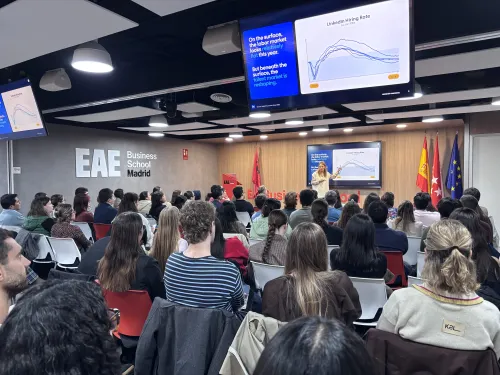
"Skills are changing dramatically," Renaldi noted. According to the forecast she shared during the session, 70% of the skills required for a particular role could change in a relatively short period, even for professionals who stay in the same position. "The key is to keep moving, and to move in a purposeful direction."
Identifying the skills required for a position and knowing how to assess them are key responsibilities for recruitment teams. EAE Madrid's Master in Human Resources and Talent Development covers recruitment and selection processes and incorporates the practical application of artificial intelligence and People Analytics in Human Resources.
CVs and LinkedIn profiles need to be consistent
Renaldi explained that there are already tools available that compare the information candidates provide in their CVs with the details on their LinkedIn profiles. She recommended ensuring that the two are consistent and highlighting the skills most relevant to the positions candidates are targeting.
To set themselves apart from applicants with similar profiles, she encouraged students to publish content on topics they know about and connect with professionals working in the fields in which they hope to build their careers. "If our profile is authentic and we send out meaningful signals, all of that will work in our favour," she explained.
Personal branding starts before the job search
When several candidates are equally well suited to a vacancy, Renaldi highlighted personal branding as one of the keys to standing out. She encouraged students to pay attention to their LinkedIn profile photo and headline and share content on subjects they know about.
During the session, she showed examples of professionals who publish content related to their areas of interest. She urged students to think about the audiences they want to reach, experiment with different types of content and observe how people respond. She recommended starting to build a professional network and engaging in industry conversations before actively looking for a job.
Future Skills brings learning into real-world business challenges
The session was part of Future Skills, a professional development initiative run by EAE Madrid in collaboration with LinkedIn. The program combines sessions in English and Spanish with hackathons in which students tackle challenges set by companies. The partnership also enables participants to earn LinkedIn certifications in skills that are in demand in the labour market.